AI-assisted research and writing · Sources checked · Preparation and sources
Start here
AI-generated usually describes material created with generative models; AI-assisted describes help with a production task. Ask which images, voices or other elements were generated. These are explanatory labels, not a universal certification.
Start with the role AI played
In this guide, “AI-assisted” means documented assistance with a production task. “AI-generated visuals” means a source specifically says the imagery was generated. “Hybrid” describes a documented combination of generated material and photographed or performed elements. A film can reasonably involve several of these at once.
The distinction matters because writing, images, motion, voice, music and editing are separate layers. Generating a background does not establish that a script, performance or score was generated. Equally, naming an editor does not establish that every part of the image was photographed.
These terms are explanatory choices for reading production information. When a filmmaker uses a different label, retain their wording and explain the disclosed facts instead of silently replacing it with a more dramatic claim.
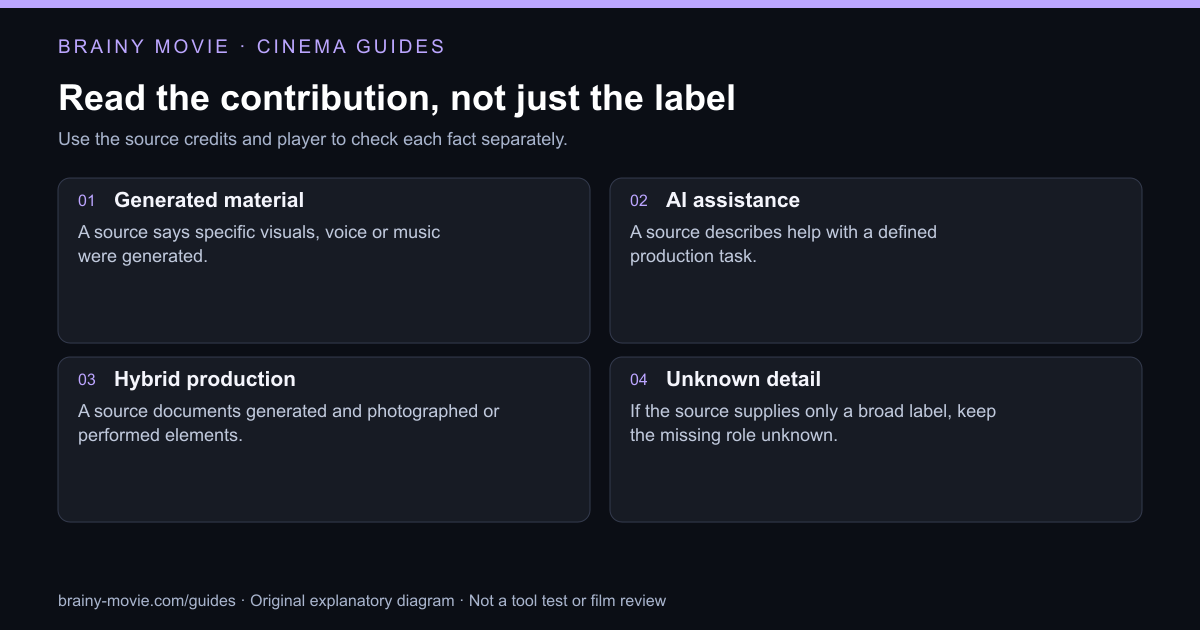
- Generated materialA source says specific visuals, voice or music were generated.
- AI assistanceA source describes help with a defined production task.
- Hybrid productionA source documents generated and photographed or performed elements.
- Unknown detailIf the source supplies only a broad label, keep the missing role unknown.
Read a production statement at the right level
Specific credits are usually more informative than a single headline claim. The table shows how to limit an inference to the evidence actually supplied.
On a small screen, swipe or scroll sideways to see every column. Keyboard: focus the table and use the arrow keys.
| Statement | A reasonable reading | What it does not prove |
|---|---|---|
| “AI-generated visuals” | Generated imagery is part of the work | That the dialogue, script, score or edit was generated |
| “Human-written screenplay” | The creator attributes screenplay writing to a person | That no AI was used elsewhere |
| “Edited in DaVinci Resolve” | The named editing application was used | That its AI features were used, or that the imagery was generated |
| “Live action with generated backgrounds” | Photographed/performed and generated elements are combined | That every shot follows the same workflow |
| A tool hashtag | A product is associated with the upload’s description | Its exact role, model version or extent of use |
Compare documented examples without guessing
Filofilm’s original description of JOURNEY HOME attributes visuals to Runway, Seedance and Midjourney, color grading and sound design to DaVinci Resolve, and the score to Suno. That is much more specific than the phrase “AI film”. It still does not disclose every shot’s model, number of iterations or full working process. Read the creator’s description.
The original description of FINDING ALEX distinguishes human writing, direction and editing from generated cinematic visuals and performances. This is a creator-declared division of work, not an independently audited production report. Read P24 Pictures’ account.
Adobe’s account of My friend, Zeph describes live-action footage, virtual production and generated backgrounds, alongside hand-painted childhood drawings on a robot model. That is a concrete hybrid example: the useful explanation is the combination, not the assumption that everything came from one generator. Read the production account.
“Generated” does not mean no human choices
A film can use generated images while people develop the story, choose references, plan shots, reject outputs, cut sequences and design the soundtrack. Conversely, a largely photographed film can contain generated frames or a localized voice track. These are different questions from whether the result is compelling.
The maker-hosted FAQ for The Frost describes generated DALL·E 2 imagery alongside continuity work and separate writing, directing, animation and editing roles. It is a historical production example, not a statement about what all current models can do. Read the makers’ FAQ.
Claims such as “fully AI-generated” need a stated scope. They may refer to visuals, several production layers, or the maker’s preferred label. Unless the account explains the scope, quote or attribute the label and leave the missing detail unknown.
Platform labels are useful context, not full credits
YouTube’s AI disclosure guidance covers realistic generated or meaningfully altered content and distinguishes it from some production assistance. Such a label can describe wholly or partly altered material. It does not provide a complete filmography, assess artistic merit or identify every contributor. Read YouTube’s disclosure guidance.
Absence of a label is not proof that no AI was used. A platform display, creator description and end-credit sequence can provide different pieces of information. Read them together, while keeping uncertainty visible.
Use the labels to understand, then choose a film
A conventional movie about a robot or artificial intelligence is not automatically an AI-generated movie. Subject matter describes the story; generation describes how material was produced. A fantasy film with no AI characters may nevertheless contain generated imagery.
Production labels also do not establish whether a release is complete, a trailer or a demonstration. Use the film-versus-video guide for that separate question. When choosing a watch, combine source information with runtime, audio language and your own interests, then form your opinion from the film itself.
Sources and how this guide was prepared
This guide uses AI-assisted research and writing. Production details are attributed to the linked sources; the guide is not a first-hand film review or a tool test. Sources and featured listing facts checked . Availability and source information can change.
- YouTube: disclosing use of generative AI — Platform disclosure examples and limits; not a film-quality or authorship certificate.
- Filofilm: JOURNEY HOME original upload — Creator-declared visual tools, grading, sound design and score.
- P24 Pictures: FINDING ALEX — Attributed human and generated production roles.
- Adobe: how the MAX 2025 festival shorts were made — Named filmmaker accounts of Beta Earth, My friend, Zeph and other workflows; a vendor-hosted account, not an independent tool test.
- The Frost: maker-hosted production FAQ — The makers describe generated imagery, continuity work and separate creative roles.
Request a correction · Read our discovery and attribution policy